
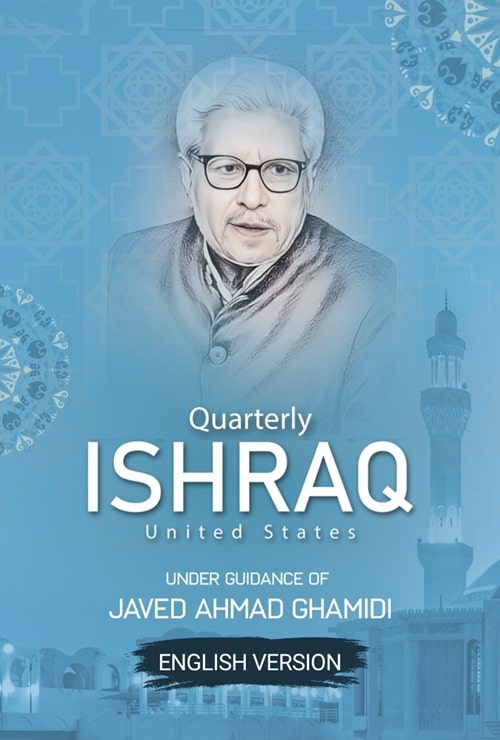
Javed Ahmed Ghamidi explains that the real objective of Din must be defined by Din itself and its authentic sources. If these sources are not silent on the matter, then there is no need to infer the broader objectives of the Shari‘ah through human reasoning. He argues that the Maqasid-e-Shari‘ah framework tends to focus primarily on the worldly implications of Islamic law.
According to Ghamidi, the primary objective of Din is Tazkiyah al-Nafs — that is, the purification of the soul. This encompasses the purification of every aspect of one’s being across all roles and domains of life. As human beings, we are required to purify our bodies, nourishment, family life, social interactions, and spiritual pursuits. Ghamidi believes that the Maqasid-e-Shari‘ah framework does not fully incorporate this central goal and instead emphasizes the worldly benefits and underlying wisdom behind certain legal rulings based on human reasoning.
He also points out that the Maqasid-e-Shari‘ah are not fixed. While earlier scholars such as Imam al-Shatibi and Imam al-Ghazali limited the list to five core objectives, contemporary scholars like Nejatullah Siddiqi have proposed expanding the list in view of modern socio-political realities.
Ghamidi maintains that such a discussion is more appropriate in the context of Muslim legal discourse — particularly with respect to laws enacted by Muslims in their own regions and time periods. He contends that the Maqasid-e-Shari‘ah approach implicitly seeks to present religion as a complete code of life.
Five Foundational Maqasid
- Hifz al-Din (Protection of Religion)
- Hifz al-Nafs (Protection of Life)
- Hifz al-‘Aql (Protection of Intellect)
- Hifz al-Nasl (Protection of Lineage)
- Hifz al-Maal (Protection of Wealth)
Key Clarifications Regarding Maqasid-e-Shari‘ah
- The framework is not an independent source of Shari‘ah; it supplements the Qur’an, Sunnah, ijmaʿ, and qiyas.
- Tazkiyat al-Nafs is embedded within Hifz al-Din.
- In absence of explicit text or direct qiyas, Maqasid can guide contemporary rulings.
- It prevents formalistic loopholes like ḥiyal that undermine Shari‘ah’s ethical spirit.
- It enriches discourse by integrating multidisciplinary perspectives.
Examples of Maqasid Application
- Hifz al-Nafs: Permitting haram food in extreme necessity.
- Hifz al-Nasl: ʿIddah rules and prohibition of extra-marital relations.
- Hifz al-‘Aql: Alcohol prohibition to protect intellect.
- Hifz al-Mal: Ban on theft to protect economic justice.
Maqasid-e-Shari‘ah and Policy Implications
| Maqasid-e-Shari‘ah | Implications in Policy Design and Approach |
|---|---|
| Spirituality (Hifz al-Din) | Belief and value system emphasizes moderation, responsibility, and justice. |
| Physiology (Hifz al-Nafs) | Emphasis on ending hunger, malnourishment, ensuring cleanliness and sanitation. |
| Intellect (Hifz al-Aqal) | Emphasis on human capital including education and innovation. |
| Sustainability (Hifz al-Nasl) | Emphasis on resource conservation, biodiversity, and ecosystem sustainability. |
| Economy (Hifz al-Maal) | Emphasis on employment, equitable distribution, and economic opportunities. |
This demonstrates how Islamic ethical paradigms — through the Maqasid lens — align with modern frameworks such as the UN Sustainable Development Goals (SDGs) and ESG (Environmental, Social, and Governance) standards.